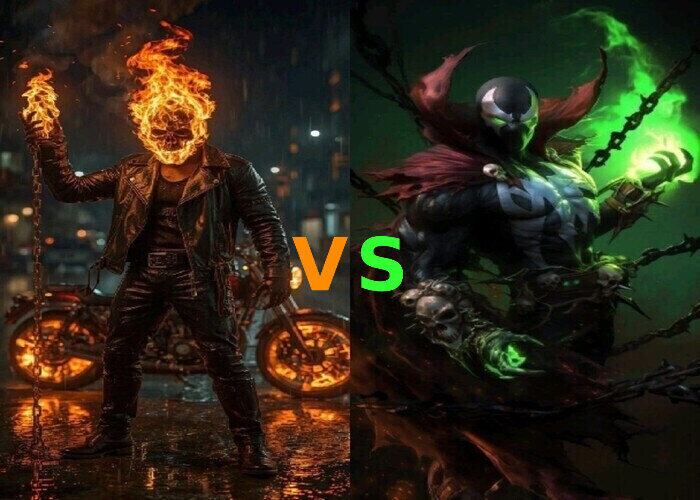
Ghost Rider at Maximum Potential
Strongest Form: A fully unleashed Zarathos operating without host restrictions, no longer filtered through human limitation or moral restraint. At this level, Ghost Rider ceases to function as a simple possessed vigilante and instead manifests as a high-tier metaphysical entity whose nature blends infernal punishment with celestial authorization. Across several continuities, Zarathos is not merely demonic but has ties to corrupted angelic origins or divine oversight, reinforcing the idea that his role transcends Hell alone.
This version of Ghost Rider is not just powerful. He is necessary. He exists because the universe requires a mechanism for retribution when moral imbalance reaches a breaking point.
Power Source: Ghost Rider draws strength from a cosmic mandate rather than a finite energy pool. His power is fueled by the existence of sin, guilt, and moral transgression, functioning as an execution protocol embedded within Marvel’s metaphysical order. Unlike typical demons who draw power from Hell, Ghost Rider’s authority is hybridized, blending infernal force with celestial sanction. This makes his power less about raw output and more about legitimacy.
Role: The embodiment of vengeance as a universal principle. Ghost Rider does not merely punish wrongdoing. He enforces cosmic consequence. As long as sin exists as a concept, Ghost Rider has reason to exist. While he can challenge Hell Lords and dominate infernal realms, he still operates beneath the highest cosmic abstracts such as Eternity or the Living Tribunal, remaining an enforcer rather than a supreme architect.
Key Strengths:
- Infinite stamina with no fatigue, exhaustion, or depletion
- Conceptual existence that reforms as long as vengeance exists
- Divine-infernal hellfire that burns guilt and sin rather than physical matter
- Direct soul punishment bypassing conventional durability
- Authority derived from higher cosmic structures
Spawn at Maximum Potential
Strongest Form: Divine or God Spawn, achieved after consuming the forbidden fruit of the Tree of Knowledge and absorbing the forces governing cosmic equilibrium during the Armageddon arc. This form represents Spawn at the absolute ceiling of his narrative power, where he no longer serves Hell, Heaven, or balance but stands above them.
At this point, Spawn is not rebelling against the system. He has replaced it.
Power Source: Spawn’s power originates from transcendent necroplasm fused with divine, elemental, and cosmic forces. Unlike Ghost Rider, his godhood is not assigned. It is seized. Spawn exploits loopholes in metaphysical law, accumulates power through conquest and understanding, and reshapes reality through force of will. He defeats God and Satan within his cosmology and rewrites universal structure, though he remains explicitly beneath the true omnipotent creator figure represented by the Mother of Existence or the Man of Miracles.
Role: A self-made god and reality architect. Spawn does not enforce existing law. He overwrites it. He possesses universal-scale authority within his narrative framework and can resurrect himself through mechanisms he authors rather than inherits.
Key Strengths:
- Large-scale reality manipulation and metaphysical rule alteration
- Legion-based multi-soul structure granting layered defense and redundancy
- God-killing weapons designed to sever divine and infernal power connections
- Instantaneous teleportation across space and dimensions
- Self-sustaining power architecture immune to external disconnection
- Vast necromantic summoning and army projection
Important Note: Both characters suffer from extreme variance across writers and eras, ranging from grounded vulnerability to near-omnipotence. This evaluation strictly considers their highest demonstrated, internally consistent peaks.
The Metaphysical Jurisdiction Question
Before abilities are compared directly, one issue overshadows the entire confrontation.
Whose Rules Apply in Neutral Territory?
This single variable can quietly decide the battle before the first attack is even thrown.
Scenario A: Marvel’s Cosmic Hierarchy Is Recognized
In this scenario, Ghost Rider functions as an officially appointed enforcer of cosmic vengeance. His mandate is acknowledged as legitimate universal law rather than a localized system. His attacks carry authority, not just force. The Penance Stare and hellfire are no longer simply weapons but sanctioned judgments. Spawn’s morally complex history, no matter how justified or tragic, could register him as a valid subject within this framework.
Scenario B: Spawn’s Self-Authored Autonomy Dominates
Here, Spawn’s seized godhood places him outside all external jurisdiction. His power is intrinsic, not granted, and therefore not subject to revocation or enforcement. Mandate-based abilities lose their authority against a being who has rewritten his own metaphysical status. Spawn operates as a peer to universe creators rather than a defendant before cosmic law.
Scenario C: Contested Space, the Most Probable Outcome
Neither cosmology fully overrides the other. Ghost Rider’s mandate applies to Spawn’s sins and human history but not to his transcendent godhood. Spawn can reshape local reality but cannot erase Ghost Rider’s conceptual nature. The battle becomes a prolonged clash between enforcement and autonomy.
This unresolved question alone introduces a swing of roughly 20 to 30 percent in victory probability.
Key Interaction Mechanics
1. Penance Stare vs. Legion Structure
Ghost Rider’s Best Case
The Penance Stare locks onto Al Simmons as the core consciousness anchoring the Legion. Instead of dispersing guilt, the thousands of souls amplify it, creating a cascading overload. Judgment spreads across the collective, overwhelming Spawn’s mental and spiritual defenses almost instantly.
Ghost Rider’s Worst Case
The Stare disperses harmlessly across Legion. No single consciousness receives full judgment. Divine transcendence places Spawn beyond guilt entirely. The attack registers as irrelevant.
Most Likely Outcome
Partial effectiveness. Al Simmons experiences intense disruption while Legion absorbs the excess. Some souls are purged or destabilized, but Spawn remains functional.
2. Divine Hellfire vs. Transcendent Necroplasm
Best Case
The divine component targets necroplasm at a conceptual level, bypassing regeneration and forcing Spawn to actively counter damage rather than ignore it.
Worst Case
Necroplasm’s transcendence nullifies punishment-based fire entirely.
Likely Outcome
Effective pressure without decisive lethality.
3. God-Killing Weapons vs. Conceptual Existence
Best Case
Weapons sever Ghost Rider’s manifestation from his mandate, collapsing Zarathos into a weakened state.
Worst Case
Only physical avatars are disrupted. The concept reforms immediately.
Likely Outcome
Tactical disruption rather than permanent removal.
Ghost Rider’s Advantages
1. Conceptual Embodiment and Erasure Resistance
Ghost Rider is not merely empowered by vengeance. He is vengeance expressed as an active force. Spawn has destroyed gods who occupied positions within hierarchies, but those beings were still entities. Ghost Rider represents a response mechanism. Destroying his form does not erase the need for him to exist.
Edge: Moderate to significant in extended conflicts.
2. Metaphysical Mandate and Authority
If recognized, Ghost Rider’s attacks are not optional interactions. They are enforcement actions. This elevates his damage from harm to judgment.
Edge: Highly variable. Potentially decisive.
3. Divine-Infernal Hellfire
This is not Hell’s fire alone. It burns guilt, intention, and moral weight. Durability becomes secondary.
Edge: Moderate.
4. Infinite Stamina and Pressure
Ghost Rider does not tire. He does not slow. Over time, this becomes oppressive.
Edge: Grows with battle length.
5. Soul Punishment Hax
The Penance Stare remains one of the most dangerous single-target abilities in fiction when it works.
Edge: Extreme variance.
6. Persistence and Reform
Even destruction is a delay, not a victory.
Edge: Attrition advantage
Spawn’s Advantages
1. Legion Multi-Soul Defense and Cognitive Redundancy
Spawn’s Legion structure is one of the most effective counters to soul-based attacks in supernatural combat. Thousands of bound souls operate as both a defensive buffer and a distributed consciousness network. This means attacks that rely on targeting a single mind, soul, or emotional core rarely achieve clean results. Even if Ghost Rider manages to damage or purge segments of the Legion, Spawn does not immediately lose agency. Thought processes, reaction time, and combat execution persist through redundancy. This directly undermines Ghost Rider’s most dangerous win condition.
Edge: Significant. It does not nullify soul hax entirely, but it prevents instant defeat.
2. Versatility and Reality Manipulation Supremacy
Spawn’s toolkit dwarfs Ghost Rider’s in breadth. He can alter matter, rewrite environmental rules, manipulate energy states, bend space, raise the dead, reshape his own form, and impose metaphysical constraints on the battlefield itself. Ghost Rider fights with focused, thematic tools that are extremely potent but limited in variety. Spawn fights with options. Options win wars.
Edge: Major. He dictates how the fight unfolds.
3. Combat Intelligence and Tactical Processing
Al Simmons was an elite black-ops operative before death. That experience does not vanish with godhood. It scales upward. Combined with the sentient K7-Leetha suit, Spawn effectively fights on multiple cognitive layers at once. One layer plans, another adapts, another executes. Ghost Rider relies heavily on instinct, wrath, and mandate-driven aggression. That works against lesser foes. Against a strategist with reality control, it becomes a liability.
Edge: Significant. Spawn controls tempo and spacing.
4. God-Killing Weapons and Power-Severing Tools
Spawn possesses weapons explicitly engineered to sever divine and infernal power links. These are not generic blades. They are metaphysical instruments designed to disrupt immortals at their source. Against beings who rely on granted authority or cosmic connections, this is devastating. Even if Ghost Rider’s conceptual nature prevents permanent erasure, temporary severance creates massive tactical openings.
Edge: Moderate to significant. Disruption is often enough.
5. Mobility and Positioning Control
Instant teleportation fundamentally alters combat dynamics. Spawn does not need to approach. He does not need to chase. He can reposition instantly, attack from any vector, or disengage at will. Ghost Rider’s Hell Cycle is incredibly fast but still directional. Spawn’s mobility is absolute.
Edge: Major. Prevents Ghost Rider from setting conditions.
6. Rule Rewriting and Metaphysical Adaptation
Spawn’s godhood allows him to manipulate the underlying rules of reality within contested space. While he may not override Ghost Rider’s conceptual existence outright, he can adjust conditions to reduce effectiveness, impose limitations, or introduce new constraints. This adaptability is especially dangerous in prolonged engagements where learning and iteration matter.
Edge: Moderate to major, depending on jurisdiction dominance.
7. Summoning, Army Projection, and Battlefield Saturation
Spawn can flood the battlefield with necromantic forces, Legion constructs, and dimensional entities. Ghost Rider excels in focused confrontation, not multi-front warfare. Even if these forces cannot kill Ghost Rider, they can distract, restrain, and create openings for higher-tier attacks.
Edge: Moderate. Tactical leverage rather than raw damage.
8. Environmental Manipulation and Psychological Warfare
Spawn actively weaponizes the environment. He distorts terrain, alters gravity, weaponizes darkness, and applies psychological pressure. Ghost Rider thrives on intimidation, but Spawn has lived in horror. Psychological warfare is not a weakness for him. It is a tool.
Edge: Minor to moderate. Accumulates over time.
9. Self-Sustaining Power Architecture
Spawn’s power does not flow from an external source that can be severed. It is intrinsic. Even god-killing weapons cannot unplug what is self-contained. This makes him resistant to many classic divine counters that rely on disconnecting authority or supply.
Edge: Significant defensive advantage.
10. Adaptation Speed and Pattern Exploitation
Spawn learns quickly. Every failed exchange becomes data. Over time, he identifies patterns in Ghost Rider’s approach, timing, and escalation. Ghost Rider’s fighting style is thematically consistent. Spawn exploits consistency.
Edge: Minor initially, grows significantly over time.
Genuine Draws and Uncertainties
1. Immortality and Reform Mechanics
Neither combatant has demonstrated a reliable method to permanently erase the other’s form of existence. Ghost Rider reforms as vengeance. Spawn resurrects through self-authored metaphysical mechanisms. Victory may be temporary by definition.
Assessment: True draw. Neither can conclusively end the other.
2. Energy Interaction Compatibility
Divine-infernal hellfire colliding with necroplasmic-divine synthesis has no canonical precedent. Whether one energy type overrides, neutralizes, or destabilizes the other is unknown.
Assessment: Genuine uncertainty.
3. Weakness Exploitation
Ghost Rider’s effectiveness drops against remorseless or transcendent beings. Spawn’s history shows vulnerability to specific divine artifacts, though resurrection often follows. Spawn has more tools to exploit Ghost Rider’s weaknesses than the reverse.
Assessment: Slight edge to Spawn.
4. Sin and Guilt as Metaphysical Anchors
Ghost Rider’s power explicitly targets guilt. Spawn’s history is morally complex. Betrayed, damned, manipulated, and violent. Whether godhood erases guilt or merely suppresses it remains the single most volatile variable in the matchup.
Assessment: Could heavily favor Ghost Rider or be entirely irrelevant.
Scenario-Based Analysis
Quick Engagement (First 5 to 15 Minutes)
Spawn favored at 75 to 80 percent
Spawn immediately controls spacing through teleportation, denies setup, and applies reality manipulation. Ghost Rider struggles to land decisive tools early.
Medium-Length Battle (15 to 60 Minutes)
Spawn favored at 65 to 70 percent
Ghost Rider’s stamina becomes relevant, but Spawn’s versatility still dominates engagement flow.
Extended Attrition (One Hour or More)
Spawn favored at 60 to 65 percent
Ghost Rider’s persistence grows dangerous, but Spawn’s adaptation and rule rewriting prevent collapse.
Bloodlusted Peak Engagement
Spawn favored at 75 to 80 percent
No hesitation. Full reality control. Maximum weapon deployment.
In-Character Encounter
Spawn favored at 55 to 60 percent or stalemate
Moral overlap likely leads to de-escalation rather than annihilation.
Final Verdict
Overall Win Rate: Spawn 65 to 70 percent
Spawn wins most encounters due to superior control, versatility, and counters. Ghost Rider, however, is never out of the fight. His conceptual nature, infinite stamina, and soul-based win conditions ensure real upset potential or eternal stalemate.
This matchup is compelling because it cannot be solved cleanly. It is a clash between imposed judgment and seized divinity. Between enforcement and transcendence.
Spawn is favored.
Ghost Rider is dangerous.
And neither can be dismissed without ignoring what makes them iconic.
Key Points
- Epic Peak Clash
This is the kind of matchup that makes power scalers pause and smile
Unchained Zarathos Ghost Rider shows up as a divine infernal punishment engine
Divine Spawn arrives as a self made god who rewrote the rules instead of asking permission
It is cosmic law enforcement meeting cosmic rebellion and neither one is bluffing - The Penance Stare Wildcard
Ghost Rider carries one of the most famous soul attacks in comics
If guilt matters this thing hurts badly
Spawn however runs on a Legion system with thousands of souls acting like spiritual shock absorbers
Sometimes the Stare overwhelms
Sometimes it spreads out
Sometimes it does nothing
This single interaction can flip the entire fight or do absolutely nothing and that is why it is terrifying - Hellfire vs Necroplasm Interaction
Regular hellfire usually does not impress Spawn
He has lived in worse
But Ghost Rider does not use regular hellfire
His flames mix divine judgment with infernal punishment
That makes things interesting
Not an instant win
Not a shrug either
Think meaningful damage with a lot of resistance and adaptation involved - Tactical and IQ Edge
Al Simmons was trained to plan ambushes exits and worst case scenarios for a living
Add a sentient suit that thinks while he fights
Ghost Rider on the other hand is pure momentum wrath and pressure
Effective but predictable
In chess terms Spawn plays several boards at once while Ghost Rider flips the table and sets it on fire - Mobility Advantage
Ghost Rider is fast
Very fast
But Spawn does not travel
He disappears
Teleportation and dimensional jumps let Spawn choose where the fight happens and when it stops
Speed is great
Instant relocation is better - God Severing Tools
Spawn owns weapons designed to mess with immortals
They do not always end fights
But they disrupt power flow timing and stability
Against a being tied to a mandate that matters a lot
Even a few seconds of disruption can change the entire exchange - Versatility and Ability Depth
Ghost Rider hits hard and hits consistently
Chains fire soul judgment repeat
Spawn shows up with reality warping necromancy battlefield control summons and rule bending
More tools means more solutions
That does not guarantee a win
It guarantees options - Immortality and Attrition
Both characters are extremely difficult to keep down
Ghost Rider reforms as long as vengeance exists
Spawn writes his own comeback rules
If the fight drags on Ghost Rider benefits from infinite stamina
Spawn benefits from adaptation and creativity
Neither wants this to turn into a long night - Scoreboard Snapshot
Spawn edges ahead in versatility tactics mobility and counters
Ghost Rider leads in stamina conceptual persistence and potential cosmic authority
Some categories stay locked in draws because nobody has proven dominance there - Overall Verdict
Spawn wins more often mostly due to toolkit depth and resistance layers
Ghost Rider always has upset potential
Stalemates are realistic
This is not a stomp
It is a debate engine and that is exactly why it works
Fun Facts
- The Penance Stare has worked on insanely powerful characters before and completely failed on others depending on guilt mindset and writer mood
- Spawn Legion soul count has shifted over the years but early stories placed it in the thousands which explains the built in redundancy
- Johnny Blaze was inspired by real life stunt culture which explains why Ghost Rider fights like someone who never learned the word brake
- Todd McFarlane created Spawn during a creative era filled with heavy metal themes dark antiheroes and rule breaking designs
- K7 Leetha is not just armor it is a thinking partner and occasionally an enemy
- The Hell Cycle ignores physics because physics never signed the contract
- Al Simmons backstory pulls heavily from real world black ops betrayal narratives which grounds his tactical mindset
- Ghost Rider hellfire is about judgment not temperature which is why durability alone does not solve it
- Divine Spawn power scaling stops below the true creator entity which keeps the cosmology intact
- Spawn teleportation is one of the reasons speed based opponents struggle against him
- Ghost Rider chains are absurdly versatile but still need setup and timing
- Spawn toys dominated shelves in the 1990s while Ghost Rider dominated edgy biker aesthetics
- Both characters pull from real myth inspired concepts vengeance spirits and hellbound warriors
- Each character has suffered from power inconsistency across decades which fuels endless debates
- Fans have argued about this matchup since the 1990s and still have not settled it
Comedy Corner
- Ghost Rider never runs out of stamina but definitely runs out of patience
- Spawn teleporting mid fight feels like lag switching but cosmic
- Penance Stare working or failing is the ultimate coin flip ability
- Ghost Rider fights like every problem personally insulted him
- Spawn brings an entire toolbox to a fight where the other guy brought divine chains
- Hellfire solves many problems but not all of them unfortunately
- Legion souls are basically spiritual group chat notifications
- If this fight goes long both characters are still standing but everyone else has left
- Ghost Rider does not strategize he escalates
- Spawn does not escalate he adjusts
- Reality warping is basically cheating but still legal in comics
- Both characters would absolutely hate team ups even if they worked well
- No matter who wins fans will still argue in the comments
- This matchup survives because neither side feels robbed
- Somewhere a cosmic being is watching this and regretting granting powers